
A wealth tarot spread is one of the most practical readings you can learn, not because it tells you what your future holds, but because it helps you think clearly about your relationship with money. Done well, it turns vague financial anxiety into specific, answerable questions. This guide walks you through a complete five-card spread you can do at your own table, with no special talent required.
Before You Begin
Tarot rewards a calm, deliberate approach, so spend a few minutes setting up rather than rushing into the cards.
Choose a quiet time when you will not be interrupted. Clear a flat surface and have a notebook nearby, because writing down what you draw is where most of the value lives. You do not need candles, crystals, or any particular ritual, though if a small grounding habit helps you focus, use it. The goal is simply to arrive present and honest.
Decide on your question before you touch the deck. A wealth spread works best with an open, reflective prompt rather than a yes-or-no demand. Instead of asking "will I be rich this year," ask something the cards can actually illuminate, such as "what shapes my relationship with money right now, and where can I grow." The quality of your question sets the ceiling for the quality of your reading.
A note on mindset
- Approach the reading as structured self-reflection, not fortune-telling.
- Stay curious about uncomfortable cards instead of flinching from them.
- Remember that you, not the cards, hold responsibility for your decisions.
Step One: Center and Shuffle
Hold the deck in your hands and take a few slow breaths. Let the day's noise settle. As you shuffle, keep your question gently in mind. There is no perfect shuffling technique; do whatever mixes the cards thoroughly and feels unhurried. Some readers cut the deck into three piles and restack them. The mechanics matter less than the attention you bring.
When the shuffling feels complete, and you will usually sense a natural stopping point, set the deck down. You are ready to lay out the spread.
Step Two: Lay Out the Five Positions
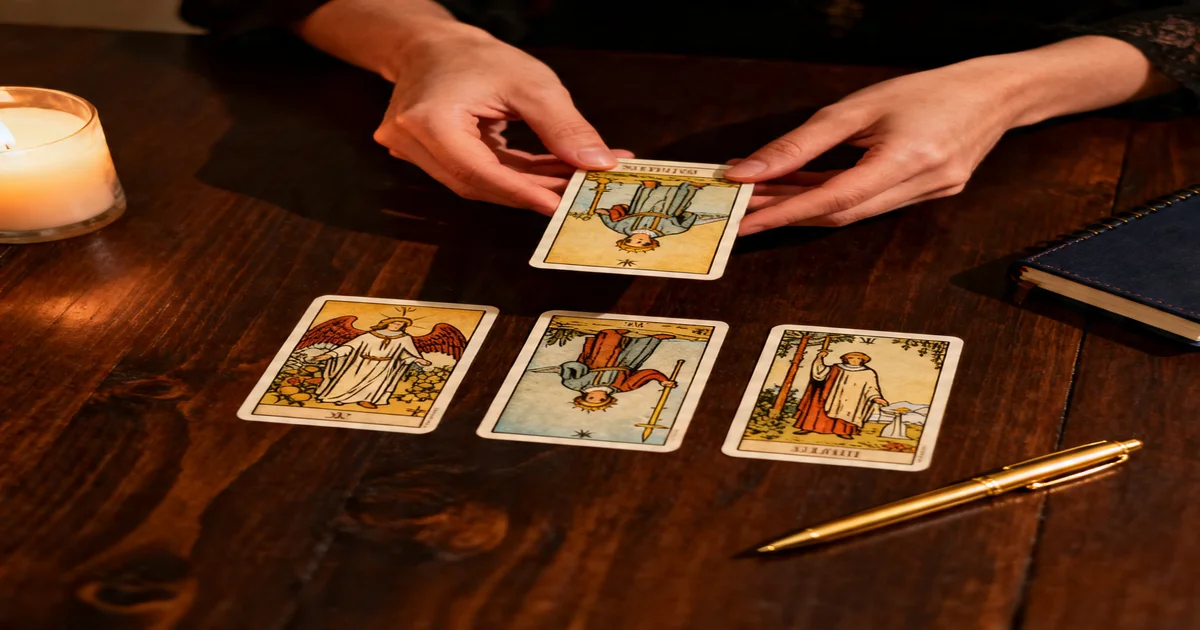
Draw five cards from the top of the deck and place them left to right, or in a small cross if you prefer. Each position has a fixed meaning, and that structure is what turns five random cards into a coherent story. Here is the layout I teach most often.
Position 1: Your current foundation
This card describes your present relationship with money: your baseline attitude, your stability, the ground you are standing on. It sets the tone for everything else and answers the question, where am I actually starting from.
Position 2: The hidden influence
This card reveals something operating beneath your awareness: an old belief about money, an inherited fear, a habit you have not examined. It often explains why your finances feel the way they do even when the surface facts do not fully account for it.
Position 3: The challenge
This card names the obstacle or tension you are working with. It might point to an external pressure or an internal pattern. Read it not as a threat but as the specific knot the reading is asking you to understand.
Position 4: The opportunity
This card highlights an opening, a strength, or a path forward that is available to you now. It is the counterweight to the challenge, showing where movement is genuinely possible.
Position 5: The guidance
This final card offers the overall counsel of the spread: the attitude or action the reading is encouraging. It gathers the others into a direction you can carry forward.
Step Three: Read Each Card in Place
Now interpret the cards one position at a time. Resist the urge to leap to the last card first. The spread tells a story in sequence, and reading it in order keeps you honest.
For each card, ask two questions. First, what does this card generally mean. Second, and more important, what does it mean sitting in this particular position. The Three of Pentacles in the foundation position speaks of collaborative, building energy at the root of your money life. The same card in the challenge position might suggest that you are overly dependent on others to make progress. Position transforms meaning.
A card never means just one thing. It means one thing here, in this seat, answering this question. That is the whole art of reading a spread.
Write a sentence or two for each card as you go. Do not aim for poetry; aim for honesty. The act of putting the card's message into your own plain words is where the insight crystallizes.
Step Four: Read the Cards Together
Once each card has spoken in its position, step back and look at the whole spread as a single picture. This is the part beginners often skip, and it is the most valuable part.
Notice the relationships. Does the opportunity card directly answer the challenge card, or do they seem to be talking past each other? Is the hidden influence quietly driving the foundation? Look at the suits too. A spread heavy with Pentacles is grounded in the material and practical. A spread sprinkled with Cups brings emotion into your money story. A burst of Swords suggests that the real work is mental, about beliefs and decisions, more than about cash itself.
Questions to ask of the whole spread
- What single sentence would summarize the story these five cards tell together?
- Which card surprised you most, and why?
- Where does the spread agree with what you already suspected, and where does it push back?
- What is one concrete thing you could do differently this month in response?
Step Five: Close and Record
End the reading deliberately. Gather the cards, thank yourself for the honest attention, and most importantly, write down the full spread in your notebook: the date, your question, the five cards in their positions, and your summary sentence. This record is a gift to your future self. Returning to old readings months later often reveals patterns you could not see in the moment, and it teaches you how the cards tend to speak to you specifically.
Avoid the temptation to immediately re-draw because you did not like what came up. Pulling the same question repeatedly until you get a pleasing answer empties the practice of its value. Sit with what you received. If the spread was uncomfortable, that discomfort is usually pointing at something worth your attention.
Common Mistakes to Avoid
A few habits trip up newcomers, and naming them will save you frustration.
The first is reading the cards as fixed predictions. A wealth spread describes patterns and possibilities, not guarantees. No card can promise an outcome, and you should be wary of any interpretation that claims to.
The second is ignoring position meaning and just stacking up card definitions. The structure is half the reading. A card means something different depending on where it lands, and honoring that is what separates a real spread from a pile of guesses.
The third is asking the cards to make your decisions for you. Tarot is a thinking tool. It can clarify your options and surface your blind spots, but the choice, and the responsibility for it, always remains yours.
Adapting the Spread
Once you are comfortable, you can adjust this layout to fit your situation. For a reading focused on a specific decision, rename position four "the path if I act" and add a sixth card for "the path if I wait." For a longer-term reflection, you might read this spread at the start of each season and compare how the cards evolve across the year. The five-position skeleton is reliable enough to build on, and personalizing it deepens your connection to the practice.
A Reflective Close
A wealth tarot spread is not a shortcut to riches and was never meant to be. It is a structured way to sit with your money life honestly, to name the foundation you stand on, the fears running quietly underneath, the challenge in front of you, the opening available, and the wisdom to carry forward. Practiced patiently, it becomes a steadying ritual, a regular appointment with your own clarity. Lay the cards, read them in order, listen to the whole picture, and let the spread do what tarot does best: help you see yourself more truthfully, so you can choose your next step with open eyes.
This article is offered for reflection and personal insight. It is not financial, medical, or professional advice.
Continue exploring: The Fool's Journey, Read Through the Lens of Abundance and Jupiter Transits and Windows of Opportunity.