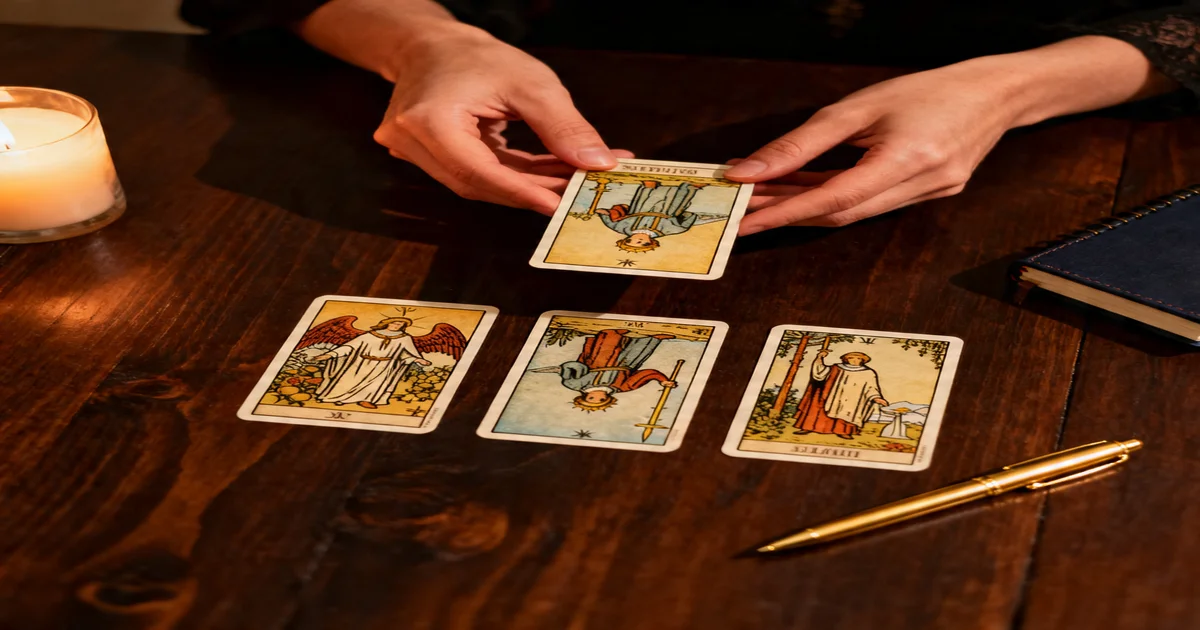
Most people who come to tarot with money questions are already frustrated. They've tried budgeting apps, read the finance books, maybe moved jobs or downsized. Yet something about their financial life keeps circling the same point. The numbers change but the feeling doesn't.
That's exactly where tarot is useful — not because it tells you which stocks to buy, but because it reveals the patterns underneath your decisions. The beliefs you hold without knowing you hold them. The fears that steer you away from opportunities. The timing of your own natural expansion cycles.
This guide will walk you through the full process: how to choose the right deck, set a clear intention, shuffle with focus, select spreads built for money questions, and actually interpret what the cards are showing you.
Choosing a Deck for Financial Readings
The deck you use matters more than people admit. Different decks carry different energetic focuses, and some are simply more useful for practical life questions than abstract spiritual ones.
For financial readings, you want a deck with clear, grounded imagery — one where the cards show people engaged in real-world action, not only cosmic symbolism. The Rider-Waite-Smith deck is the standard recommendation here for good reason: its imagery was drawn with everyday life in mind. The Ten of Pentacles shows multi-generational wealth. The Three of Pentacles shows skilled craftspeople collaborating. The Six of Pentacles shows the give-and-take of financial exchange. The scenes translate directly into modern financial situations.
If you already work with a deck you trust, there is no need to switch. The relationship you've built with your cards carries its own value. What matters more is the intention you bring.
Decks That Work Well for Money Questions
- Rider-Waite-Smith — grounded imagery, strong Pentacles suit, great for beginners
- Thoth Tarot — more astrological in structure, useful if you also work with planetary cycles
- Modern Witch Tarot — contemporary settings make financial scenes easier to read intuitively
- Sacred Rose Tarot — particularly strong for emotional money patterns and inherited wealth beliefs
Avoid novelty decks with heavily abstract or humorous imagery for serious financial questions. The subconscious responds to symbolic clarity — muddled imagery creates muddled readings.
Setting Your Intention Before a Financial Reading
This step is the one most people skip, and it's why so many readings feel vague or unhelpful. Sitting down and shuffling while mentally asking "what about my money situation?" is too broad for the cards to answer clearly. You're essentially asking the deck to write your question for you — and it can't do that.
Before you touch the cards, write down your actual question. Be specific. Instead of "will I have more money soon?" try "what is blocking my ability to increase my income this year?" Instead of "should I take this job?", try "what do I need to understand about this career opportunity before making a decision?"
The best financial tarot questions are ones that point inward first — asking about beliefs, patterns, timing, and approach — rather than demanding a yes/no outcome. The cards describe forces at work. They don't override your free will or eliminate uncertainty.
A Simple Intention-Setting Practice
Hold the deck in both hands for a moment before shuffling. Take three slow breaths. Speak your question aloud or silently, clearly and once. Then begin shuffling. This physical and mental reset helps your conscious mind stop spinning and allows the intuitive channel to open.
Shuffling: Methods and When to Stop
There is no single correct way to shuffle tarot cards. The method matters far less than the consistency — use the same method each time so your subconscious associates the motion with the practice.
Overhand shuffle: Move small packets of cards from back to front repeatedly. Good for fragile or oversized decks. Allows reversed cards to emerge naturally.
Riffle shuffle: Standard playing card shuffle. Efficient, but can damage thinner cards over time. Fast and thorough.
Pile shuffle: Distribute cards into several face-down piles, then reassemble in a new order. Good for mixing without bending.
When to stop: Stop when you feel an impulse to stop — not when you've counted to some arbitrary number. This matters. Your body often knows before your mind does. Some readers shuffle until a card falls out. Others shuffle until the deck feels "settled." Trust whatever internal signal consistently works for you.
Spreads Designed for Financial Questions
Spreads give structure to a reading by assigning specific meanings to card positions. For financial questions, a good spread distinguishes between current energy, hidden influences, and potential outcomes — so you're not just pulling random impressions from a single card.
The Three-Card Money Check-In
Simple, fast, and useful for regular financial reflection.
- Card 1: Current relationship with money
- Card 2: What needs to shift or be released
- Card 3: What to move toward
Pull this monthly, or any time you feel financially stuck. Keep a journal of the results — patterns across months are often more telling than individual readings.
The Five-Card Wealth Block Spread
For deeper investigation into why abundance hasn't arrived despite effort.
- Card 1: Your core belief about money (conscious)
- Card 2: Your hidden belief about money (unconscious)
- Card 3: The behavior this belief creates
- Card 4: The root of this pattern (where it came from)
- Card 5: The first step toward shifting it
The Career Decision Spread
For specific financial decisions around work — see the dedicated article on tarot spreads for career decisions for full layouts and interpretations.
Interpreting Cards in a Financial Context
Each card carries a general meaning, but in a financial reading that meaning narrows to the domain of money, resources, and material life. Here is how to approach the four suits and the Major Arcana through that lens.
The Pentacles Suit
Pentacles (also called Coins or Discs in some decks) are the tarot's earth suit — they govern money, property, physical resources, work, and practical skills. In a financial reading, Pentacles cards carry the most literal weight. An abundance of Pentacles in a spread suggests the question is firmly in the material realm.
- Ace of Pentacles: New financial opportunity, seed capital, fresh start
- Four of Pentacles: Holding too tightly to resources, fear of loss
- Eight of Pentacles: Building mastery through focused work, skill investment
- King of Pentacles: Financial maturity, reliable wealth, smart stewardship
The Major Arcana in Financial Context
Major Arcana cards in a money reading signal that larger forces are at work — this is not just about budgeting or career tactics, but about deeper life patterns. The Wheel of Fortune appearing in a financial spread points to cyclical change you cannot fully control. The Tower suggests a financial structure that needs to break before something better can be built. The Star offers hope and gradual recovery after difficulty.
For a full exploration of how every Major Arcana card speaks to your money story, read The Major Arcana and Your Money Story.
Reversed Cards
Reversed cards in financial readings often point to internal blockage rather than external obstacle. A reversed Ace of Pentacles doesn't mean an opportunity doesn't exist — it means you may not be in position to receive it yet. Work inward first. The card is pointing you somewhere specific.
Common Mistakes to Avoid
Asking the Same Question Repeatedly
This is the most common habit to break. If you pull a spread and the answer isn't what you hoped for, reshuffling and asking again doesn't change the forces at work — it just adds noise. Pull once, sit with the reading for at least 24 hours before doing another on the same question.
Treating the Cards as Final Authority
Tarot shows you the trajectory of current energy. It does not override your choices. A card suggesting financial difficulty ahead is an invitation to change course, not a sentence. Read it as information, not verdict.
Ignoring the Cards You Don't Like
The Five of Pentacles, the Ten of Swords reversed, the Three of Swords — these are uncomfortable pulls in any context. In a financial reading they have genuine value. The cards you resist are often the ones pointing most directly at what needs attention. Sit with them. Ask what they're actually trying to show you.
Reading Without a Specific Question
As discussed above — vague questions produce vague readings. If you don't know exactly what you're asking, the deck can't answer it for you. Take five minutes to clarify your question in writing before pulling a single card.
Skipping the Journal
A tarot journal is where the real learning happens. Record the date, your question, the spread, each card pulled and its position, and your initial impressions. After a few months, read back through your entries. The patterns that emerge across readings are often more valuable than any single session.
A Note on Regular Financial Readings
Many people come to tarot only in crisis — when money feels out of control, when a big decision looms, when anxiety is high. This works, but it's not the most effective way to use the practice.
A monthly three-card check-in, consistent and low-pressure, builds a relationship between your awareness and your financial life. Over time you start to notice when your energy contracts around money. You catch limiting patterns before they fully express. You track your own progress through previously stuck places.
Tarot used this way becomes a financial clarity practice, not an emergency lifeline. That shift makes it considerably more powerful.
"The cards do not decide your fate. They describe the current shape of your choices — and that description, honestly received, is one of the most useful things you can hold."
Whether you are new to tarot or returning to it with fresh eyes, the financial dimension of this practice is one of its most grounded and immediately applicable uses. The only requirement is that you show up honestly, ask clearly, and listen without bracing for a particular answer.
Your birth chart holds a unique blueprint for abundance. Lyra will read yours personally — free, delivered within 24 hours.
Get My Free Reading